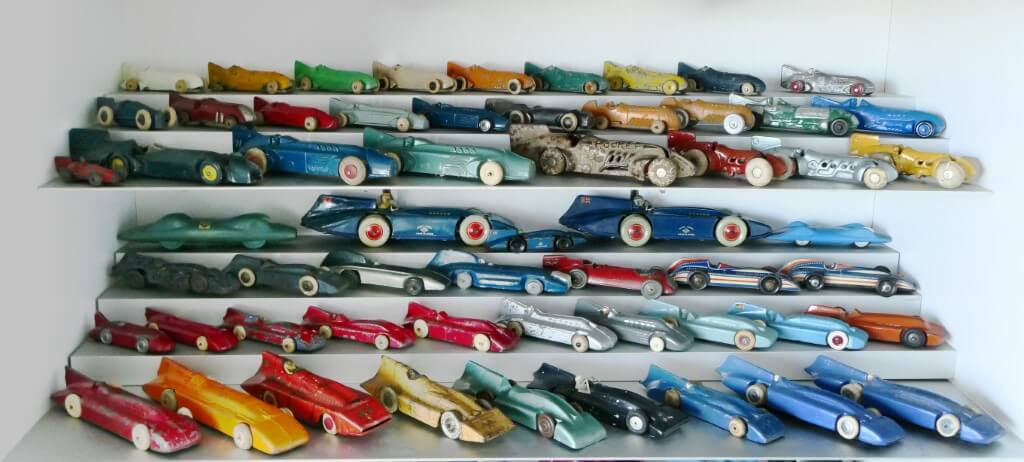
Photograph: A selection of toys from the author's collection
It took Malcolm Campbell’s 1928 Land Speed Record at Daytona Beach in the USA to capture the attention of the toy manufacturers. His previous exploits and records established in Europe didn’t get modelled until the 1970s when artisans started producing collectible scale models of Campbell’s earlier record holders, about which, more later.
The 1927 and 1928 Bluebirds
A postcard with a, probably British, tin BB.
Boys comic December 3rd 1927
Quite what Nelson Lee's young readers thought of the accuracy of this "real metal model" of the 1927 BB, shown immediately below, is hard to know. Boys had to bend a flat sheet of lithographed "Tinplate" to make this model. Clearly the results were not highly valued by young boys and these are now very hard to find.
The 1928 LSR holder was modelled in both slush molded and diecast lead as well as Zamak and cast iron - mostly in small scales. Kingsbury produced a beautiful 19 inch tinplate (actually pressed steel) in 1928. With a clockwork motor and produced with Campbell’s approval . Tootsietoys didn’t get their small lead and Zamak Models to market until 1932 but there were a variety of slush molds produced around the same time and for some years afterwards mostly in the USA. I also have a couple of small Danish ones.
This tinplate given away by "Modern Boy" allthough only a "flat" is far more realistic than the Nelson Lee model.
A selection of tootsietoy 1928 BBs. These were never described as BBs in their advertising. In fact those with numbers on their tails were included in a boxed set with a racing game where eight BBs were arbitrarily named.
Tootsietoy Speedway, USA 1932. This boxed set included a rolled paper playing board for a racing game and eight 95mm lead cars. The cars, which have cast raised numbers from 1 to 8 on their tail fins, are otherwise identical castings. Despite the body shapes being the same, they are intended to represent real cars and famous drivers of the period. These toys were also sold individually. First cast in lead, then in zamak. Later still, the zamak castings no longer had numbers on their tail fins.
Jigsaw puzzles such as this one were popular pastimes in the years before television was widely available. The producers made them in a huge variety of subjects. Cheaper ones were made of die-cut cardboard. This one, in its Art Deco box, is hand cut in plywood.
I don’t know who made this splendid large tinplate toy. Sadly it is not mine. I took the picture in a car museum in England.
USA Hubley Diecast Marked Hubley. Rubber-wheels/tyres 95mm.
The 1931 to 1933 Bluebirds
There were plenty of models of the 1931 to 1933 record holders in a variety of scales and materials as can be seen here along with some jigsaw puzzles, books and ephemera.
Gunthermann Germany tinplate clockwork 522mmKingsbury, tinplate, clockwork, USA, about 500mm? Another toy that I should like to add to my collection: this is the 1931/32 version of BB. The Kingsbury toys were much more accurate and of stronger construction than their obvious competitors such as Gunthermann in Germany. I found this photo on the internet.
A smaller, stubbier proportioned version of the Gunthermann in fig. 40.A photo from the internet; it looks to be the same as the Gunthermann in fig. 42 but simply in different colours.
Another picture from the internet. Unknown to me but probably made in England.
USA Unknown Maker Slush Mold. Lead-wheels/tyres. 67mmUSA. Lincoln Slush Mold. Rubber tyres Wooden wheels 152mm
USA Lincoln Slush Mold. Rubber-wheels/tyres 152mmUSA Kilgore. Cast Iron. Rubber tyres on nickel wheels. This, the largest of the three similar Kilgoretoys, has the word “Rocket” in raised script on the top 164mm
USA Kilgore Cast Iron. Rubber tyres on nickel wheels 110mmUSA Kilgore Cast Iron Identical in construction details to its two Kilgor sisters this is the mid sizedtoy 122mm
USA Kilgore Cast Iron Showing the clip holding together the two body halves and axlesUSA Barclay? Slush Mold Rubber-wheels/tyres. 104mmUSA Lincoln. Slush Mold. Rubber-wheels/tyres. 100mm
USA Lincoln Slush Mold Rubber-wheels/tyres 100mmThe undersides of figs. 54 and 56.
USA. Lincoln. Slush Mold. Lead-wheels/tyres. 100mm
Sweden Unknown Maker Diecast Lead. Nickel Plated. Rubber tyres on lead wheels. 111mm
A hand cut plywood jigsaw of the 1931 LSR holder, about 235mm wide. The artwork was by the famous illustrator Bryan de Grineau, who along with Gordon Crosby, both from England, and Geo Ham in France did many splendid pictures of cars and planes at speed in the 1930s. These were widely reproduced in magazines, postcards, cigarette cards and jigsaws like this one.
Cardboard jigsaw puzzle issued by Castrol in 1933 to commemorate the 1933 LSR. It was mailed directly as a “Jigsawgram”. I own the empty box but am missing the jigsaw; this photo was culled from the internet.
England. Johillco. Diecast lead Lead-wheels/tyres. Not as finely cast as the later 1935 BB byBritains but still a good basic model 178mm
These four red BBs are all slush moulds, lead, USA, pre war. From bottom to top and left to right they are Lincoln 106mm, Barclay 110mm, Barclay 110mm and an unknown manufacturer 114mm.
The 1935 Bluebird
It is the 1935 version which pushed the LSR to over 300mph that really caught the eyes of the world’s toymakers. I have versions in lead, Zamak, plaster, plastic, “flour and plaster” and tin, in sizes ranging from 6cm to about 30 cm and from about 20 different manufacturers in England, France, Germany, Japan and the USA.
A cheap cardboard jigsaw. Although the box attributes a speed of 300mph to this 1935 BB, the picture actually depicts the car racing on Daytona Beach, Florida, USA. This was in March 1935 when the car “only” attained a new LSR of 276mph. It was at Lake Bonneville, after modification to the engine air intake, that the car set a new LSR of 300mph in September the same year.
Cavacraft USA a wooden kit of parts that required sanding to shape.
I do not own this box, I found the photo on the internet.
An assembled Cavacraft BB. Wood, 240mm. I found this picture on the internet.
Three tinplate, clockwork toys from Japan by Kosuge, 331mm, 221mm and 100mm. Sadly my large one is missing a front wheel.
Two examples of the 221mm Kosuge with different styles of drivers and trade marks.
The 100mm Kosuge with its box.
USA. Lincoln. Slush Mold. Like many Lincolns this toy is more finely and crisply cast than most other American slush. 157mmUSA. Barclay. Slush Mold. No maker’s mark. Rubber- wheels/tyres. 176mm
USA. Lindstrom Tin clockwork. Marked “Lindstrom made in USA” Wooden wheels, rubber tyres. Sold in at least 8 different colours, with and without clockwork motor. 150mmJapan Unknown Manufacturer. Tin clockwork. Marked “Foreign” these were issued in a variety of colours. 148mm
Unknown manufacturer. Plastic, moulded in various colours. No maker’s mark. Bakelite-wheels/tyres. 149mmMarked “Made in England Britains Ltd” and issued as number 1400. Lead. Pre war. This is the second version issued after Malcom Campbell pushed the LSR to 301.1292mph. Of all the toy BBs, Britains were the only company to correctly model the off centre driving position and with its detailed chassis it is definitely more a model than a toy. Rubber tyres on lead wheels. Clearly these were boys’ treasured possessions as quite a few have survived. 162mm.
Marked “Made in England Britains Ltd” this is the first and much rarer version #1393 issued without the lift off body revealing the detailed chassis. The box specifies the record achieved as 276.8 mph. 162 mmThe underside of fig. 94
Underside views of fig. 94 (below) and 97 (above)Marked “Made in England by Britains Ltd” Lead. Pre war. This is a 3rd and smaller version of the same car. I do not know whether it was issued before or after #1393 but suspect that it was dropped from production when Britains issued the version with the detailed chassis. It is very hard to find. 137mm
Underside view of fig. 97Marked “Marklin Germany” on its Tin base plate. Pre war. Diecast with diecast wheels and rubber tyres. The rubber driver was sold separately as an accessory. Many early Marklins are subject to bad fatigue and actually fall apart. This one is fine but the rubber tyres have perished quite badly.
Possibly English? Unknown manufacturer. Thick Lead casting. Lead-wheels/tyres 89mmUSA. Lincoln. Pre war Slush Mold. Rubber-wheels/tyres. 115mmUSA Unknown Manufacturer. Pre war Slush Mold Similar to the Barclay in fig. 103 but with many subtle differences when examined closely. No maker’s mark Rubber-wheels/tyres. 110mm
USA Barclay BV120. #306. Pre war. Slush Mold. No maker’s mark. Rubber-wheel/tyres. 110mmUSA. Bestoy. Pre war. Slush Mold. “97” cast on tailfin. Plasticwheels/tyres are probably replacements. 113mmUSA. Ralston? Tiptoptoys? Pre war. Slush Mold. Marked “Made in USA” Rubber-wheels/tyres. 112mm
USA. Eccles. Post war, Slush Mold. Heavily cast (like most Eccles) reproduction of fig. 105 Plastic-wheels/tyres. 112mmFrance. AR Pre war. Diecast lead. Marked “A R” Rubber tyres on lead wheels 123mmUnderside view showing the clockwork motor of car in fig. 107
France Marked “A R” on the underside. Pre war. Diecast lead. With replacement plastic tyres.Underside view of car in fig. 109 showing that this is the version with no clockwork motor and no winding key hole.
France JRD. “Plaster & Flour”. Pre war. No maker’s mark. Rubber tyres on lead wheels. 123mmEngland Charbens Lead At rear Lead-wheels/tyres, front lead wheels rubber tyres. certainly produced just after the war perhaps pre war as well?
The undersides of fig. 112 I don’t know what the two ridges on the underside of the top version are for. Marked “Charbens made in England” These models are quite rare.England Unknown Maker. Plaster composite. Marked “British Made” Rubber-wheels/tyres 130mmProbably England. Unknown Maker. Plaster composite. No Maker’s mark. Lead-wheels/tyres. 141mm
England ? Unknown Maker. Tin. No maker’s mark. Tin-wheels/tyres. 125mmJapan ? Unknown Maker Tin. Marked “Foreign” Tin-wheels/tyres. The one in front with crossed flags has no base plate. 130mmThe underside view of the toys in fig. 117. I don’t know if the base plate is lost or if the toy was made like this.
Kellogg’s, plastic, 1960, 62mm. This 1960 BB and three other BBs were given away as kits in cereal packets. They are now not often found.
Lledo, England, diecast, 109mm. This 1935 BB was issued as a set of four LSR cars along with the Railton Special, Spirit of America Sonic 1 and Thrust 2.
The two Britains BB boxes. Interestingly, the end view of No. 1400 shows a peeling corner. I have deliberately left this unglued as it shows that the label is stuck down over a No.1393 label. Undoubtedly the news that Campbell’s new 1935 LSR had exceed 300mph was exciting enough for Britains to rush out a newer version of the model with the beautifully detailed chassis.
Donald Campbell’s Bluebirds
After the second world war Donald, Malcom Cambell' son took out...
England Jetex. Plastic, powered by Jetex rocket cartridges the car runs straight along a fixed fishing line run between the two tether lugs on the left side. 163mmEngland. Corgi 153 1960 Diecast. Turned aluminium wheels with rubber tyres. Re-issued in 1963 as 153a with Black plastic wheels/tyres. 127mm
Hong Kong Marx Toys Clearly one for the dedicated BB collector Plastic. 230mm
More Bluebird toys
The pictures here are marked as my own or else culled from the Internet.
Clive adds new articles and photographs to the site from time to time. Leave your email address and we will let you know when something new is published. No more than an email or two a month.