

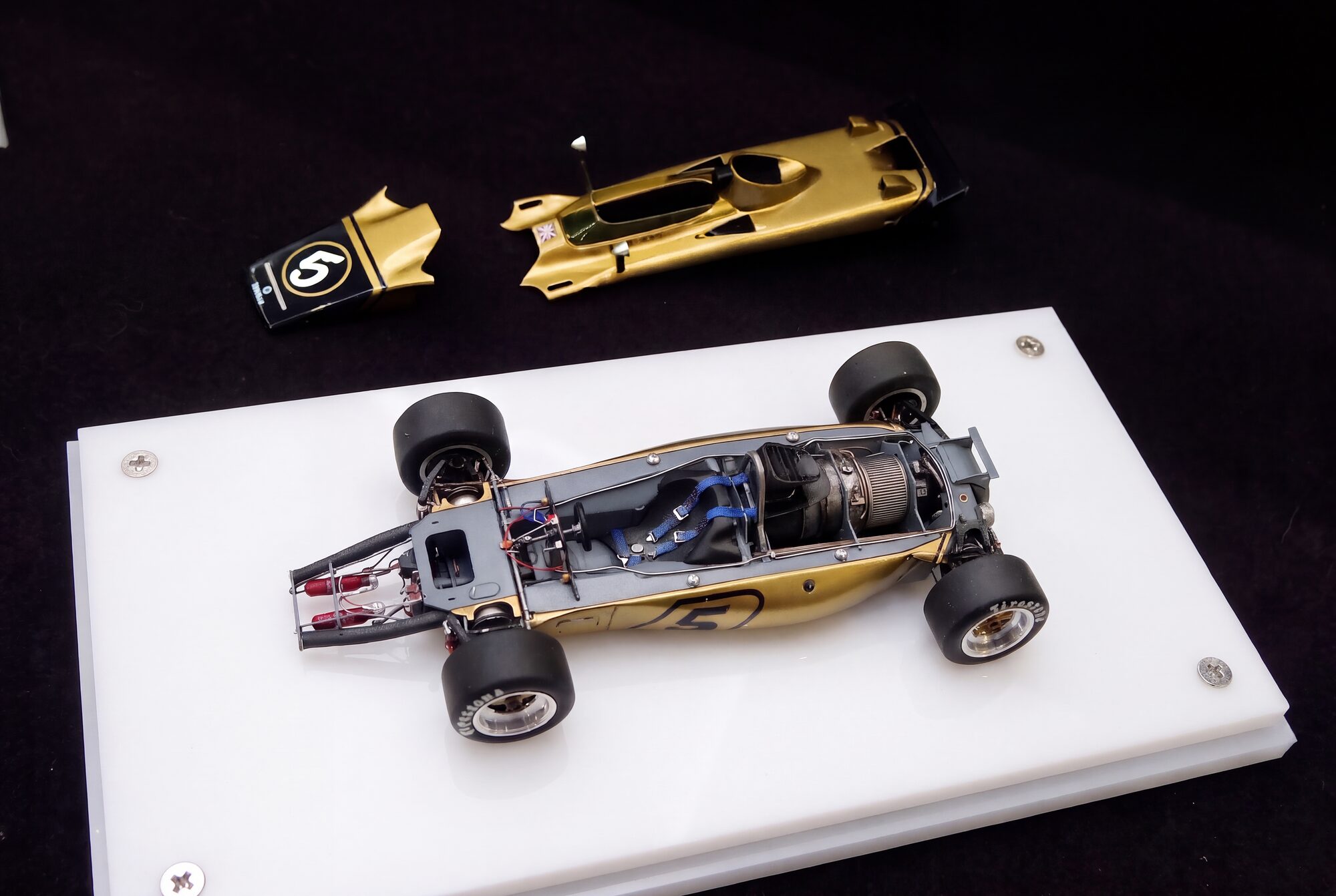
The perfect model has not yet been made, perhaps it never will be. Having seen the work of quite a few of the best model makers in the world over many years and having many wonderful models of my own, if one looks closely there is always, even in the best models, some missing detail, perhaps some wall thickness slightly over scale, a texture or reflection that does not quite ring true, a surface too shiny or too dull… Compare models of the same 1/43 car from Mini Champs, Spark and IXO and you will always find tiny differences in interpretation.
I was at the Nuremberg Toy Fair some years ago, admiring a display of splendid large scale models produced by a commercial model company. As I was gazing in real admiration at a beautiful quarter scale vintage motor bike, one of the people on the stand, who I took to be the owner, asked me what I thought of the model. I replied honestly that it was really excellent, at which he said “No it’s perfect!” Irritated by the arrogance of his tone, I pointed out that the motorcycle’s engine block would, in real life, have been sand-cast iron which would have had a subtle granulated surface finish. His model was smooth and on a model in such a large scale, open to a perfectionist’s nit picking…
This is not now written to spoil people’s pleasure in looking at models. Quite the opposite. By understanding modellers’ problems, I hope people will have a better understanding and appreciation of the results of the skills and many hours of patient work required to produce the delightful models that we collect.
All models are tricks on the eye. One material pretends to be another. Resin can stand in for metal, or leather. Plastic becomes glass. Zamak, white metal, wood and other materials replace steel. Artful painting imitates rusty or oil-stained metals. Hand-beaten or pressed steel bodies are duplicated by castings. Delicate photo-etched steel mimics parts as varied as aluminium windscreen wipers, chromed window surrounds and iron brake discs. Water slide decals and tampo printing faithfully reproduce painted numbers, racing car sponsor stickers and racing liveries. Different paints replicate metals such as chrome, aluminium, iron and steel.
Figs 3, 4 and 5 are all 1/5 scale hand builds in resin and multi-media by Patrick Buvat. He exhibits each year at Rétromobile in Paris. These models look as though they could be driven away.
Some builders generously share their model making techniques on the internet and in books, others jealously guard their professional secrets.
Different people notice and appreciate different things in a model. One person will spot that there are the wrong number of spokes on a wheel but not notice that the car’s body proportions are wrong. Many collectors want their models to be really shiny. Others think that too much gloss makes the model look as though it has been covered in honey. Some models might be thought by some people as being crude. Others will appreciate a certain charm or the better capturing of the essence of the original vehicle. This last can perhaps apply best to rally cars and especially to racing cars of the 1960’s and before.
Spark made a series of the pre WWII Silver Arrows commissioned by Mercedes. I asked the client if they would be happy if we produced the models with the worn, used look of working race cars with the scuff marks and small dents that accumulated during the racing season as opposed to a glossy showroom presentation finish. To my delight they said yes. We went ahead only to receive complaints from various collectors that their “badly finished” models were a disappointment…
All model makers, whether mass producers, commercial artisans or hobbyists are limited by their choices of materials, their patience and their skills. They will have different target customers or different philosophies. The models can be made for different purposes. Some might be unique pieces for demanding, money no-object collectors. Another might be for wind tunnel testing. Then there are toys and promotional models. Collectors’ models come as simple models or complicated ones with opening parts as well as working steering and suspension. And of course there are models built at home, whether scratch-built one-offs or commercial kits. Different collectors have different tastes.
Modelling accuracy
Spark produced a series of comments on these matters in their newsletters that were summarised on the About us page of their website. Extracts follow.
The collector’s eye
Different collectors are drawn to different aspects of a model. One person notices sharp, crisp moulding; another focuses on overall paint finish; others scrutinise fine details such as windscreen wipers, wheels, or interiors. Yet another might verify that there are the correct number of louvres but overlook a serious error in overall proportion or body shape.
As a model progresses through production, it passes through a series of evaluations. The first prototype is examined for proportion, form, and detail. Unpainted hand samples follow, and finally fully detailed and finished decoration samples undergo a last round of pre-production approval.
A close comparison between two manufacturers’ versions of the same car quickly reveals that subtle differences can have a dramatic effect on overall realism and accuracy. Occasionally the gap is so large that one model is clearly wrong.
The challenge of historic cars
We would like to say that we have never made a mistake or overlooked a detail, but in practice that is close to impossible—particularly with historic cars that no longer survive and must be recreated entirely from basic dimensions and photographs.
This is where research and deep knowledge become indispensable. Most photographs of old racing cars were taken from varying angles with different camera lenses, each introducing its own distortion and perspective. Shadows and highlights can make soft bodywork curves appear as sharply moulded lines. Only through careful study and comparison of many different images, taken from a range of angles, can one hope to arrive at an accurate representation.
On numerous occasions prototypes have been returned several times when it became clear that correcting a curve or a proportion required complete remodelling.
From prototype to production
Once a decision has been made to produce a particular car, measurements, drawings, and photographs are given to a craftsman, who then sculpts a prototype. The prototype passes through several approval stages before mould production begins. These craftsmen—who, in an earlier generation in China, might have been ivory or jade carvers—possess extraordinary skill, though their work is increasingly complemented by CAD-CAM techniques using 3D scans of classic cars and computer data supplied by modern manufacturers.
Small production runs make resin the natural choice, as tooling costs are significantly lower than for die-casting. Resin also offers a distinct advantage in that body details—extra louvres, revised air intakes, wider wheel arches, different spoilers—can be modified to reflect the specific configuration of a given racing car as it appeared at different circuits and in different seasons.
Such models are, at heart, serially produced hand-built kits, mostly manufactured in runs of hundreds rather than thousands. What had been a largely European cottage industry—resin and white-metal, small-run, hand-built models—moved to China, where skilled workers could continue the craft at far more accessible prices than European boutique producers.
The challenge is to keep that price advantage and production flexibility without sacrificing hand-built quality, and new techniques are constantly evaluated. Chrome window frames offer a good example: once simply reproduced in silver paint or, more realistically, in photo-etched steel, they are now rendered in chrome foil—producing a far more convincing finish that can be applied to curved strips and other complex surfaces.
A commitment
While we cannot promise never to make an honest mistake, we will never assume that because some collectors might not notice, we can deliberately cut corners. Because this is a passion and not merely a business, we take the process seriously—and it helps that we enjoy it, too.