

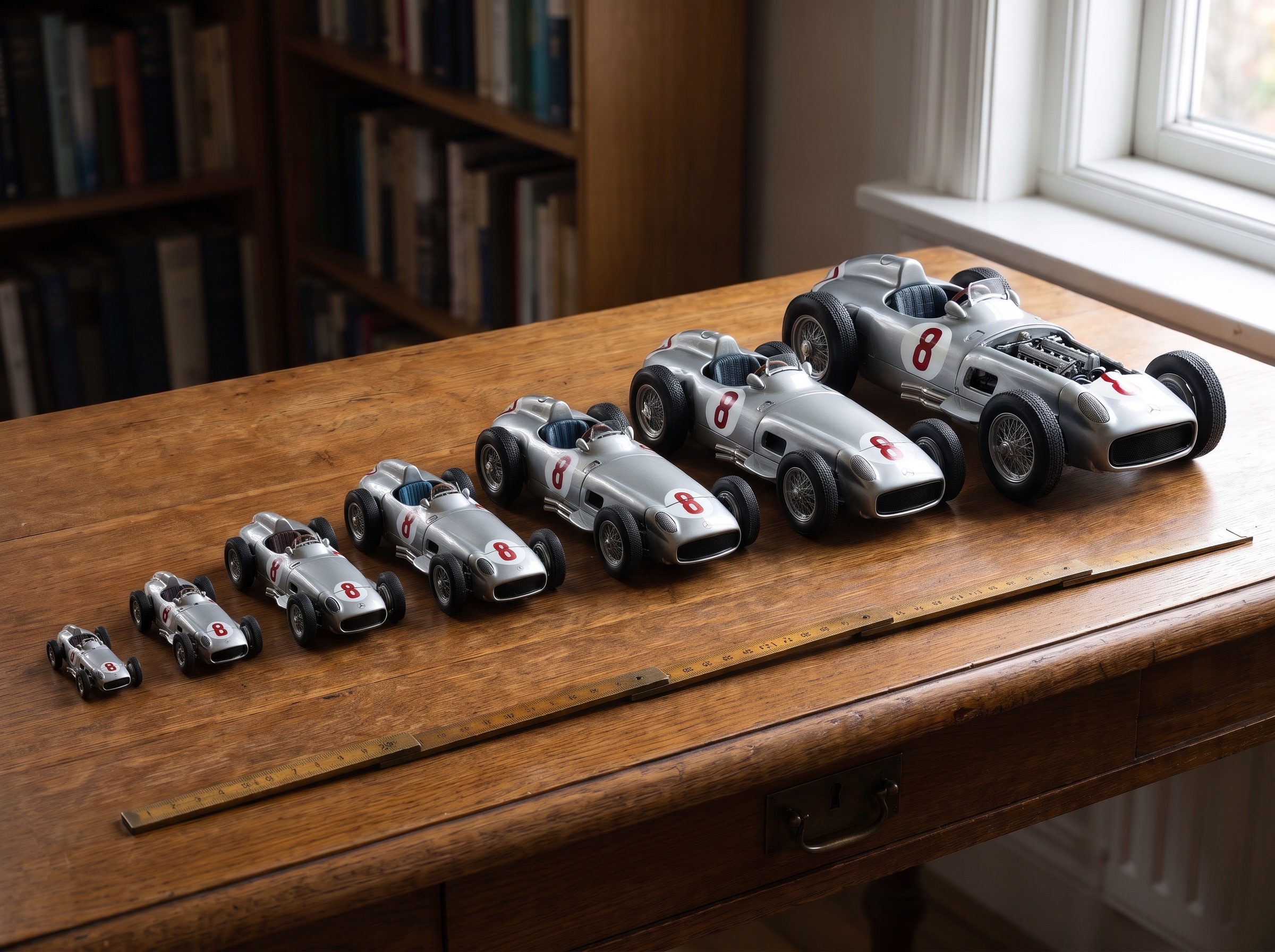
Different scales are often associated with different types of models: cars, planes, trains, tanks etc. These comments are focused on car scales.
Scale guide
The same 4.8 m car at each scale, against a 65 cm rule. Tap a scale to show or hide it.
1/87
5.5 cm · 2.2″
1/64
7.5 cm · 3.0″
1/43
11 cm · 4.4″
1/24
20 cm · 7.9″
1/18
27 cm · 10.5″
1/12
40 cm · 15.7″
1/8
60 cm · 23.6″
1/87 is a scale also known as HO gauge. It stands for “Half O” scale. O gauge was based on 7mm to 1 foot; accordingly HO is 3.5mm to the foot. Both are traditionally associated with model railways popular in Northern Europe. Vehicles made to this scale are often sold as accessories for railway layouts.
1/76 scale, also known as 00 or “Double O”, is 4mm to the foot and a scale popular for model trains in Great Britain. Dinky Toys marketed some vehicles in this scale as “Dublo”. They were not particularly successful.
1/64 scale has in recent years become extremely popular for diecast model cars. The scale’s origin is due to the success of Matchbox Toys made and sold by Lesney in England in the 1950s. In fact these very collectible toys were not made to a particular scale but were in fact sized to fit in a packaging sized and coloured to resemble a Matchbox. Thus a double decked bus, a saloon car or a dump truck were all the same size and same price. The result was not any single scale. Their worldwide popularity attracted competition from Hot Wheels who concentrated primarily on cars of a similar size to the Matchbox toys, resulting in a scale which happened to equate to about 1/64. The rest is history.
1/43 scale equates to O gauge, 7mm to the foot, and was popular in England and France for model trains. It has become the most widely collected model car scale around the world. Dinky Toys used this scale for their first toys sold in both countries in 1934 as accessories to Hornby Trains. Their accuracy and commercial success were what kick started model car collecting as other toy manufacturers in Germany, Italy and elsewhere joined the bandwagon.
1/32 scale is primarily used for plastic model car kits.
1/24 equates to 1/2 inch to the foot while 1/25 is 4cm to the metre. Being so similar, many collectors combine the two scales in their collections. These scales have been very popular for plastic car kits.
1/20 is another scale mostly used in plastic car kits, being particularly popular for F1 models.
1/18 has become popular in recent years for commercial producers of highly detailed diecast models with many working features, but also for resin models without opening doors etc.
1/12 and 1/10 scales have been traditionally used for very expensive scratch built models made to order by modellers who have become famous for their skills. These tend to be found in museums and private collections. 1/12 has begun creeping into the commercial field.
1/8 scale has been available as very large, expensive multi media kits from companies such as Pocher in Italy since the 1960s. In 1995 Amalgam started commercially producing splendid 1/8 resin multi media models of racing cars and luxury GT cars. These have always been expensive and sold mostly to owners of such cars as well as racing teams and their sponsors. Spark has also been producing similar models under its own brand along with MR who produce custom models for owners of Lamborghinis and Bugattis. Apart from their high cost they also require a lot of space to display them compared to all the smaller scales above.